
Which Laurens Release Date Applies?
Start with custody type. A person at Laurens County Detention Center may leave on bond, court order, time served, completion of a misdemeanor sentence, or transfer. The county's public inmate system supports a release-date field in sentence details, but it does not promise that every future date is displayed. A person sentenced to more than one year becomes a GDC inmate and may wait locally for state pickup. The eventual prison release date then belongs to GDC and, if parole applies, the State Board of Pardons and Paroles.
| Date | Meaning | Source |
|---|---|---|
| County release date | Departure from Laurens jail custody | Sheriff release record |
| Sentence begin date | Effective start after permitted jail-time credit and instructions | GDC computation |
| Sentence end date | Computed termination after sentence length and adjustments | GDC computation |
| Maximum release date | Date full term ends without parole | GDC record |
| Tentative parole month | Planned month for final Board review | Parole Board |
| Final parole date | Actual date set after Board review | Board release record |
Find a Laurens Projected Release
For a local jail stay, open the Laurens County inmate search and check the current, booking-date, sentence, and release-date details. If the entry is missing or incomplete, request the booking and release record from the sheriff and the sentence or bond order from the clerk. A court disposition can explain the authority, but the sheriff record is better for the physical departure from county custody.
For a state sentence, use the GDC Find an Offender page or direct query. Search by name, GDC ID, or case number, verify identity, and distinguish each displayed date. Then check the Board's TPM lookup when parole is possible.
- Identify county jail, state prison, federal, or immigration custody.
- Match the person by name plus an ID, case, age, offense, or facility detail.
- Read the label beside the date; never convert a TPM into a final day.
- Compare the sentencing order and credited jail time when the computation seems wrong.
- Confirm changes through GDC Inmate Records, the Board, the clerk, or the sheriff.
The official GDC offender-search source shows the state lookup and its verification warning:
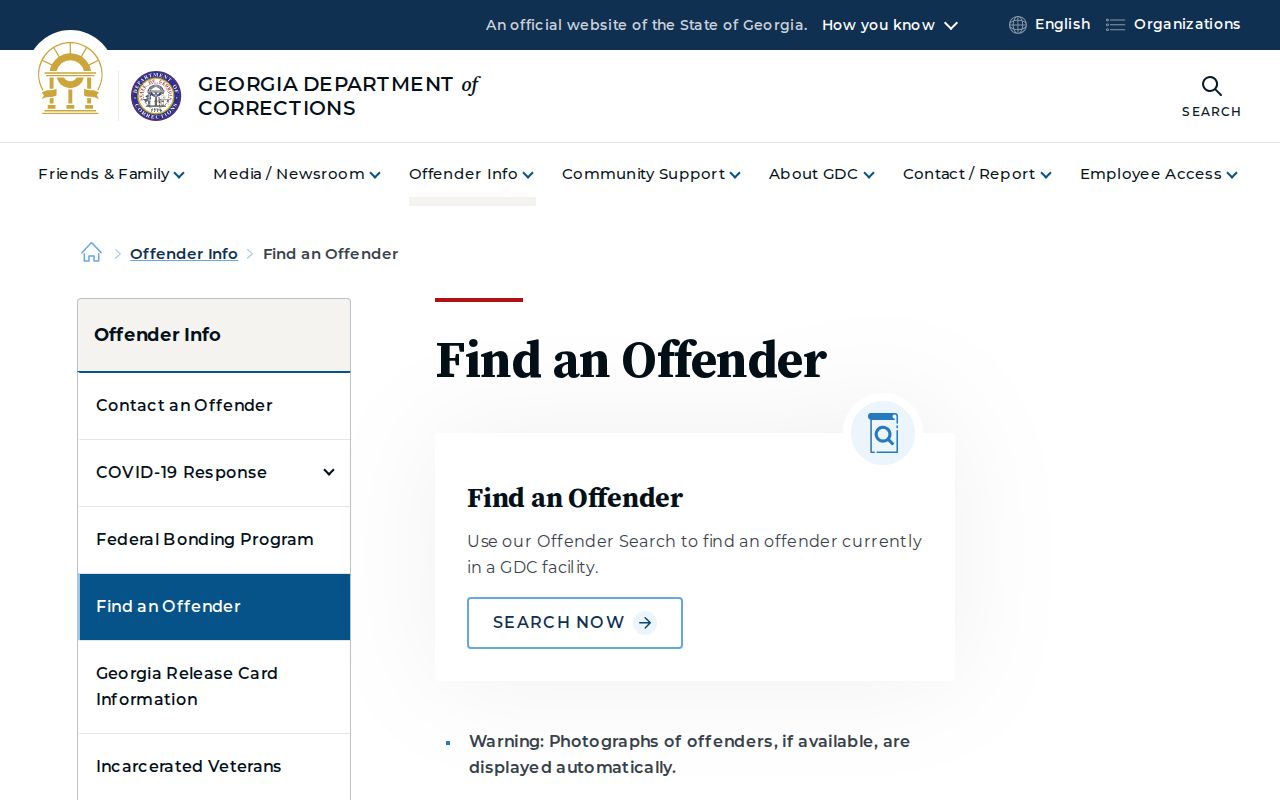
The public query is a starting point. GDC directs written verification to Inmate Records and Information when accuracy or completeness is uncertain.
Georgia Computes Laurens Prison Dates
GDC Rule 125-2-4-.04 supplies the controlling vocabulary. Sentence begin date is the effective start, taking account of allowed jail time and special court instructions. Sentence end date is the effective termination after the maximum sentence length is added and non-running time or applicable credits are considered. Maximum release date is when the person would leave DOC custody after serving the entire sentence, apart from parole.
No maximum release date exists for a life or death sentence under the rule. Consecutive and concurrent sentences, credited jail days, non-running time, later court corrections, and parole action can all affect what a reader sees. A simple subtraction from the sentence length can therefore be wrong.
- Jail-time credit
- Qualifying time already served that is applied to the sentence.
- Non-running time
- A period during which the sentence clock does not advance under applicable rules.
- Maximum release date
- The full-term GDC date excluding parole.
- TPM
- A tentative parole month selected for possible placement after final review.
Laurens Good Time Has Limits
“Good time” is often used loosely, but Georgia's published rule does not support promising a standard modern deduction from every state sentence. The GDC rule describes straight-time service for offenses committed on or after January 1, 1984, except life and death sentences. Its earned-time definition concerns offenders entitled under legislation before that date.
Modern state timing depends on the court sentence, permitted jail credit, periods when the sentence does not run, statutory parole eligibility, Board guidelines and discretion, exclusions, conduct, and program conditions. County misdemeanor timing is different. It depends on the local sentence, credited custody, court changes, and the sheriff's record. Ask the correct agency to explain the displayed calculation rather than applying a generic percentage.
Laurens Parole Eligibility Is Not Release
O.C.G.A. 42-9-45 provides general eligibility thresholds with exceptions. The general felony threshold is nine months or one-third of the sentence, whichever is greater. The general misdemeanor threshold is six months or one-third, whichever is greater. The Board stresses that many people become eligible before they are granted parole. Eligibility merely allows consideration.
The Board's TPM explanation says the tentative month is conditioned on conduct and may require programs or other preconditions. Misconduct can postpone or cancel it. Final review comes later, and only then may the Board set a parole release date.
The matching TPM source capture makes the distinction concrete:
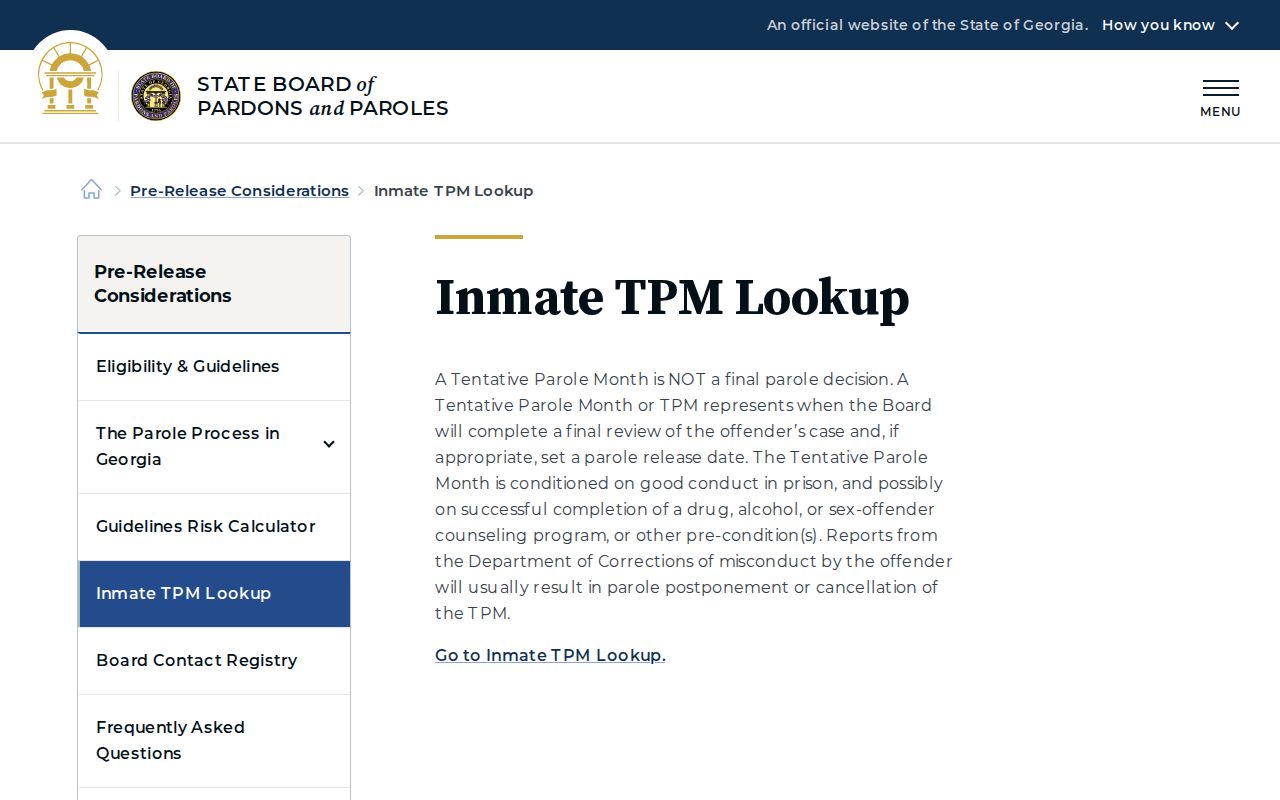
After actual parole release, the parolee search and DCS record become the better sources for supervision dates.
Mandatory Laurens Sentence Service
Georgia does not support a universal “85 percent” claim for all state inmates in the reviewed sources. Some serious violent felony sentences instead carry mandatory-service limits under O.C.G.A. 17-10-6.1. The Board identifies non-life sentences for listed serious violent felonies with offense dates on or after January 1, 1995 as not parole eligible, along with other excluded categories.
Examples listed in the research include rape, aggravated sodomy, aggravated child molestation, aggravated sexual battery, armed robbery, and kidnapping. The statute says covered sentences are served in their entirety as imposed and are not reduced through parole or early-release measures, subject to narrow provisions such as final-year transitional-center or work-release consideration.
The successful serious violent felony statute capture shows the governing limitation:
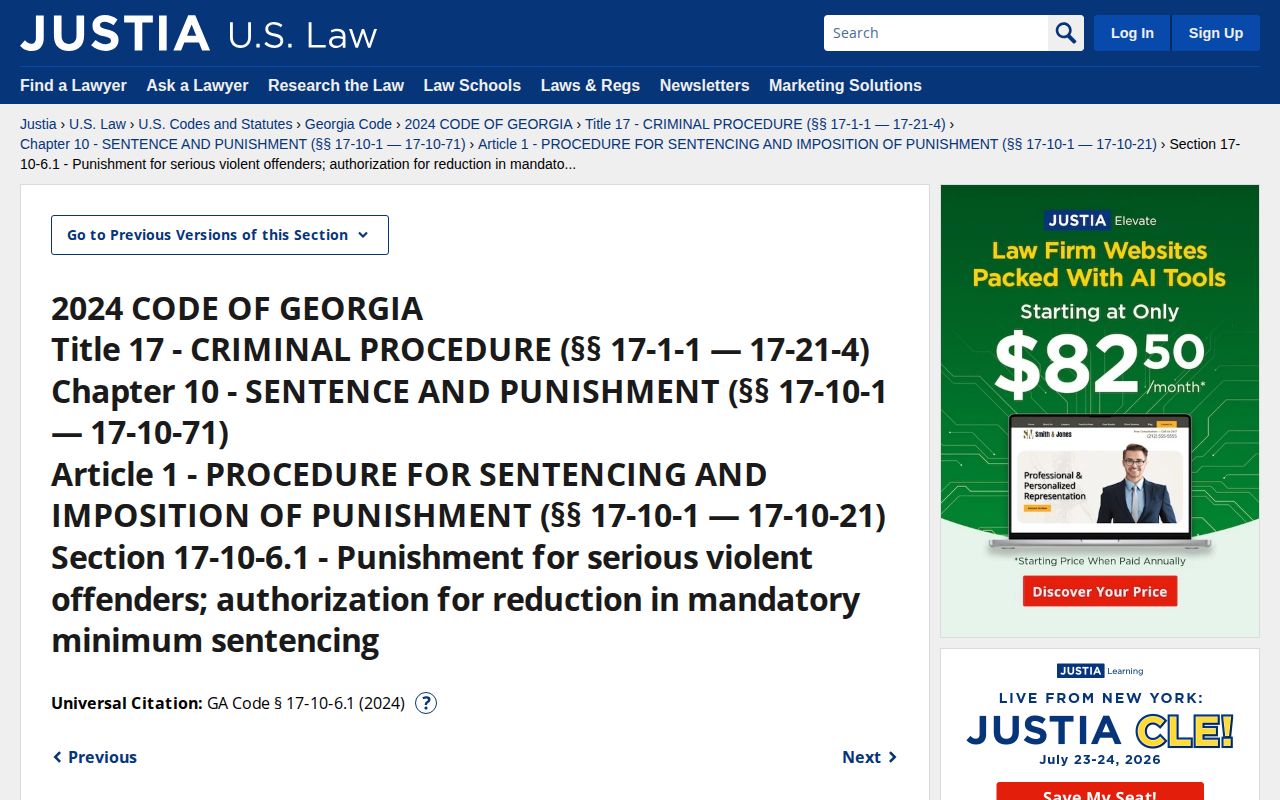
Read the actual conviction, offense date, and sentence order before deciding that the limitation applies.
Why Laurens Release Dates Change
A county date can change through a new bond order, sentence modification, revocation, added hold, transfer, or corrected jail credit. A state date can change after a corrected sentence document, non-running time, disciplinary action, unmet parole conditions, a new Board decision, or a court amendment. Data-entry and identity issues can also make a public result appear inconsistent.
Trace the change in order: sentencing court, jail or GDC computation, Board action, then supervision status. Do not rely on an old screenshot or a date repeated without its field label. VINE may send a custody-change alert, but it does not replace the sentence calculation or final order.
Property After Laurens State Release
GDC's offender-administration rule also addresses personal property. At reception, property is surrendered to a receiving officer, who makes a written inventory signed by both people. Tangible property left unclaimed for one year after parole, discharge, escape, or death may be declared abandoned and sold.
This is a GDC rule, not a stated Laurens County jail policy. Determine which agency last held the property. Contact the county detention center for county custody and the relevant GDC facility for state custody. A transfer can shift both the release-date record and the property custodian.
Request a Laurens Date Record
For county custody, ask the Laurens County Sheriff's Office for the booking and release entry, release date, reason, authority, credited local time, and transfer destination. The detention center is at 511 Southern Pines Road, Dublin, GA 31021, phone 478-272-1522. Ask the clerk for the sentence, bond, modification, or revocation order.
For state custody, write GDC Inmate Records and Information, PO Box 1529, Forsyth, GA 31029. Include the full name, GDC ID, case number, county, and the exact date field needing clarification. If parole is involved, request the related Board record too. Probation & Parole explains the post-release stage.
Laurens County Jail Date Factors
A future county release date is often less stable than a state maximum date. A pretrial detainee may bond out as soon as the authorized bond is satisfied, remain until court, or stay because another hold applies. A sentenced misdemeanor inmate may receive jail-time credit, complete a term under one year, or return to court for a modification. The county roster cannot predict every court action.
When the person disappears from Current Inmates, inspect the booking-date entry and request the release reason. A transfer to GDC, another county, federal custody, or immigration custody ends the local jail stay without ending confinement. Ask for the receiving authority, then move the search to that agency. A projected county date that ignores detainers or transfer orders can mislead.
Read Laurens Sentence Documents
The sentencing order is the foundation for a GDC computation. Confirm the sentence length, whether multiple counts run together or one after another, the offense date, and the amount of jail credit stated or later certified. Court clerks transmit certified sentencing and jail-time documents when a person is committed to GDC. A missing or corrected document can affect the agency calculation.
Use the case number to connect the Laurens court file to the GDC result. If a displayed date seems inconsistent, ask which source document controls it and whether an amended order has been processed. The public search may lag a correction. Neither a family estimate nor a calendar count overrides the recorded computation.
Laurens TPM Final Review
The Board's process continues after a tentative month is assigned. A TPM reflects a planned year and month for parole placement, subject to final review. The Board can impose program or conduct preconditions, accept or reject guideline recommendations, and act before sentence expiration. A parole consideration date for a life sentence is also not a release date.
Check the TPM source again near the expected month and verify actual movement through GDC, the Board, or VINE. Once release occurs, use the parolee search for supervision dates and office. If the TPM passes without release, request the current Board status rather than assuming the system failed.
Track Laurens Date Updates
Keep each date with its exact label and retrieval day. A sentence end date, maximum release date, parole consideration date, TPM, and final parole date answer different questions. Include the agency and case identifier when recording the value. This prevents an old tentative figure from being repeated as a fixed promise. It also makes later changes easier to trace through the court, GDC computation office, or Parole Board action. Recheck the responsible source near any expected release window.